Showing posts with label Samuel Dahl. Show all posts

15 July 2017

Andover, Illinois


Soybeans, Henry County, Illinois. The power company pays $1000+ per year for each windmill.  This almost was your family farm...


.

One of the most influential events in the history of Jamestown, New York happened a hundred and sixty-nine years ago in the summer of 1848 and 625 miles (1000 km) west in Andover, Illinois. You could even argue that the decision made that summer by Samuel Dahl was the most consequential decision ever made by any single individual in the history of our area.

In 1848 Samuel Dahl [1846.001] traveled from Buffalo, New York to Andover, Henry County, Illinois to see the farming and living conditions of a new Swedish settlement there. He returned to the Swedes working as farm laborers in Hamburg township (Erie County, New York) with an unfavorable opinion. Several families decided to go to Andover anyway, but the remaining group decided to settle near Germund and Catherine Johnson’s farm in Sugar Grove, Pennsylvania.


Accounts of the Trip


The information about this trip comes from a single source, Frederick J. Johnson [1846.003].  Johnson was interviewed late in life by A.J. Lannes and the account of the trip in Civic and industrial progress of the Swedish people in Jamestown, 1848-1914 noted:

The plan of the party stranded in Buffalo had been to join the Bishop Hill settlement [sic ] in Illinois as soon as they had earned enough to pay their way there.  Samuel Dahl even went westward for an investigation but returned to those who had remained in Buffalo and Hamburg (to which an addition of later immigrants also had come) with a harrowing tale of hardship and privation for their co-migrants and of bad drinking water in the western country.  Frederick Johnson, who seems to have been the leader of the group, made a decision there and then to move with his family and kin and clan up to that fine country where Germund and Catherine were located, and which they had described as both fertile and beautiful.  He went ahead with Samuel Dahl to look up sites, and on the 13th day of October, 1848, the other “trekked” to Sugar Grove, using horse wagons for their conveyance.

An earlier account with different details was included in the article “Svenskarne i Sugar Grove (Pennsylvanien), Jamestown (N.Y.) och å kringliggande platser.” published by Hemlandet on 28 Mar 1877. That article included information that was almost certainly contributed by the same Frederick J. Johnson. Its likely author, Johan Alfred Enander (the editor of the paper), wrote this account1  of the events:

Month after month passed and they were filled with difficulties and trials. One year after the arrival in Buffalo, two of the Swedes, Hans Hurtig and Samuel Samuelson, left for Andover, Illinois. When they got there, they wrote their friends in Buffalo that, if they wished to come to Andover, they would be met with conveyances at Chicago. As a result of this letter, six or seven families journeyed to Andover in August, 1848.

... Germund Johnson therefore returned alone to Buffalo to get the rest of his family and his possessions and bring them to Sugar Grove. On the strength of his description of that place, Frederik Johnson and Samuel Dahl, both of whom had been to Andover but were dissatisfied with the soil there, accompanied him to Sugar Grove to "spy out the land."


The Trip Itinerary


These accounts suggest that Samuel Dahl returned to Buffalo with his opinion about the conditions in Andover before the families who made the decision in favor of Andover left in August 1848.  These accounts also indicate that the fellow Swedes who had migrated to Andover in the summer of 1847 had written to the group and that Dahl's trip was in response to that letter.  It is likely then that Samuel Dahl made his trip after the Spring planting in 1848, sometime from May to July of 1848.2 

Henry Schenck Tanner. Tanner's Universal Atlas, 1844, p 31.  Library of Congress permanent link: lccn.loc.gov/map45000245
The most likely route that Samuel Dahl would have taken was by lake steamer from Buffalo to Chicago. Advertised steamship travel from Buffalo to Chicago indicate that the trip would have taken three or four days. After arriving in Chicago, which had a population of about 20,000 in 1848, Dahl might have found support (lodging) from the small Swedish population there.

The distance from Chicago to Andover is about 170 miles  (270 km).  If he had been lucky, Dahl could have taken a packet or line boat on the newly opened 96 mile Illinois & Michigan Canal from Chicago to LaSalle. This travel required one full day (24 hours). From LaSalle it would be 80 miles to Andover, by stagecoach. It's more likely that Dahl went on foot – a distance similar to that walked by Germund and Catherine Johnson enroute to Sugar Grove.3  That amounts to about three days walking and a total minimum travel time from Buffalo to Andover of one week.

Overall, the trip would have taken about three weeks and would have cost the equivalent of 15 or 20 acres of undeveloped land in Warren County. The cost of the steamship one-way from Buffalo to Chicago was likely about $6 with better accommodations onboard costing $10. My guess is that this investigative trip was a communal decision and that the overall cost was shared in some manner.

The timing of Samuel Dahl's trip was fortuitous.  While much warmer than western New York, the weather in Illinois during the summer of 1848 seems to have been a little cooler than normal.  The next summer (1849) was marked by the outbreak of cholera along the entirety of this route. Hans Hurtig,4  one of the Swedes named in the 1877 article, died in Andover in 1849.

Named Factors for the Decision


The reason given in the 1877 account, the condition of the farm land in Andover, is nearly stupefying. A comparison of the contemporary USDA rating of soils on Germund Johnson's farm in Chandlers Valley indicate a typical productivity for corn at 80 to 105 bushels per acre, oats at 65 to 80 bushels per acre and hay at 3.0 to 3.5 tons per acre. The rating for the soils near Andover indicate a typical productivity for corn at 140 to 195 bushels per acre, oats at 70 to 105 bushels per acre and hay at 3.2 to 7.0 tons per acre. The prairie soil was unfamiliar to the Swedes and its mechanical qualities (stickiness) made it difficult for iron plows of this era (John Deere had introduced his improved steel plow in 1837). But generally speaking, you can look at the land and see that it would be much better for farming and Samuel Dahl was an experienced farm worker.

The later account (Lannes, 1914) indicated that Samuel Dahl had encountered problems with water quality. In an era of cholera, typhoid and other diseases this was a major concern. Henry County is normally a little bit dryer than our region. The rainfall in Henry county is typically 37 inches (930 mm) of rain and 27 inches of snow. Sugar Grove has an average of 44 inches (1115 mm) of rain and 80 inches of snow; and Erie County (where they were working) gets 41 inches with 108 inches of snow. The Henry County prairie has slow moving creeks rather than the fast moving small streams and rivers of Warren County.

The misery that may be referenced in the Lannes account could be the situation at the Bishop Hill Colony5 during the summer of 1848. Bishop Hill was a religious colony/society near Andover where members of the Eric Jansson sect settled. Most of this group were from northern Sweden and began arriving in numbers in 1846. In 1848 there were possibly 800 - 1000  immigrants, although several hundred of them arrived later in the summer. Historical accounts indicate that a shipful of Janssonites had arrived at the colony with a disease (questionably listed as scurvy), and that about thirty of this party died in Bishop Hill after an extended and horrific battle with the malady. That episode was made worse by the religious leadership who forbade medical treatment and promoted fasting and prayer as the cure. Outside parties attempted to intervene, including Jonas Hedstrom, the brother of Olof G. Hedstrom and a Methodist minister.


Unnamed Factors for the Decision


It's hotter in Andover – just as cold as our area in the winter, but 90° F (32°C) weather in the summer is common and 100°F (38°C) is not unusual. Enough said for a Swede who is concerned about work, not vacation.

It is prairie land in Andover. It doesn't look anything like the terrain around Lönneberga where Samuel Dahl was born and worked. There are two small lakes, swamps and ponds near the beginning of the Green River in the north, but no major lake in the area. There were some wooded areas, but Bishop Hill had to bring in lumber from outside the area quite early in its construction.

I would suggest that it was the absence of substantial forests (sustainable woodlots) that may have been the pivotal factor in the decision against moving to Andover. The importance of the forest and a good edge tool to a Smålander likely superseded the attractive features of Andover. The woods of Warren and Chautauqua counties would provide a self-reliant independence for these Swedish immigrants.

Accounts indicate that it was very tough cutting through the native sod to turn the prairie into cultivated land, but that effort pales compared to the work involved removing tree stumps from a forest land to make it tillable. It is quite a price to pay for a place that looks like home.


Sophisticated Decision Making 


While this trip by Samuel Dahl is a footnote in our histories, I find the communications involved and the investigation conducted to be signs of a fairly sophisticated community, albeit that they were penniless immigrants.

The group of Swedish immigrants who arrived in 1847 and settled in Andover wrote to their compatriots in Buffalo.6   That seems simple until you consider the logistics.

First, how do you find out where another group of immigrants is living?  That information would have been gathered from either 1) triangulated communication through letters home to Sweden; 2) triangulated communication through an intermediary such as the Hedstroms and the Bethel ship who communicated with both groups; or most likely, 3) a Swede who happened to meet someone from the Virginia group in Buffalo and then met the Swedes in Andover, Illinois.  It is no small feat making this connection.

Second, how do you successfully get a letter to the other group?  Most likely, that was accomplished by the U.S. mail, but you need to be able to send it to a fixed address.  That is complicated when the recipients are day laborers and farm workers.

The letter that is referred to in the 1877 article is a much simpler communication – it seems likely that Samuel Samuelsson, one of those who left Buffalo for Andover in 1847, would have written to his fourteen year-old son, Samuel Leonard, who had been taken in by the Swift family in East Hamburg.

Next, the group had to raise enough money to pay for an expedition. Remember, these immigrants were on the margin of subsistence.  Then, the group needed to send someone who they could agree upon as dependable and who they could trust to provide a fair report.  This speaks volumes about the character of Samuel Dahl.

Once Dahl returned from Andover, then a further aspect of the group was shown.  The Swedes in Buffalo did not make a decision as a cohesive group.  Instead, half chose to go to Andover based on Dahl's report and half chose Sugar Grove.  Unlike the passengers of the Augusta who had pooled their resources to get to Iowa (see blog footnote), the passengers of the Virginia acted as family units whose responsibility to the larger community was limited.


Endnotes

  1. This text is from an anonymous translation made of the later, slightly revised article by Rev. H.O. Lindbland that is in the collection of his papers archived at the Swenson Center, Augustana College.

    I doubt that Frederick J. Johnson made this trip (as indicated in the 1877 article). The high cost of the trip and the absence of any indication in the A.J. Lannes history strongly suggest that the trip was made only by Samuel Dahl.  

    Also, in my opinion, Frederick J. Johnson’s short (auto)biography in Schenck’s History of Warren County, 1887, p  Li (51) was somewhat boastful (I have not been able to verify his land holdings) leading me to believe that if he had indeed made this trip that he would have made note of it in this write-up.

    Another passenger from the Virginia may have also gone West to investigate and returned to the group in Buffalo (alone or with Samuel Dahl).   Anders and Ingrid Catherine Norman are credited as the second Swedish settlers in Burlington, Iowa in 1847.  Anders Norman died there in 1871 and "Carrie" Norman died in Burlington in 1896.  However, in our local histories one member of the small group who settled in Sugar Grove in October 1848 was the old soldier Norman. That was clearly a reference to Anders Norman [i2160], yet there is no reference to his wife or his son.  Both of these two historical notes might be correct, but they demand a peculiar sequence of events best explained by a scouting trip.

  2. It is unlikely that Dahl would have missed work during the Fall harvest in 1847 and the Spring planting of 1848.  Travel during the winter months was very difficult and lake traffic stopped for several months.

  3. A shipload of Janssonists arrived during the summer of 1848 having walked from Chicago to Henry County.

  4. Hans Hurtig [O-W 2091] arrived 6 March 1847 in New York City aboard the Edla from Stockholm. Hurtig was not connected to any of the passengers of the Virginia who were in Buffalo. Hurtig was an ex-Janssonist who likely met Samuel Samuelsson in Buffalo and then traveled together to Andover. Hurtig died of cholera in 1847 or 1849 (Olsson and Wikén, 1995: 294).

  5. The Bishop Hill Colony was an anomaly in Swedish immigration. It can be compared to the later immigration of Swedish converts to Mormonism – both emigrations were typically organized by the church hierarchy. The Janssonist emigration was substantial and represented an important portion of all Swedish emigration during a decade beginning in 1846.

    Their settlement in Henry County was largely due to the influence of O.G. Hedstrom in New York and his connection with his brother Jonas Hedstrom in Victoria, Illinois, near Henry County. There is a great deal written about this sect. See Wikipedia or this article by H. Arnold Barton for additional basic information.

    It is very clear from the migration of the Swedish immigrants who arrived aboard the VIRGINIA in 1846 that their initial destination was Jefferson County, Iowa and Peter Cassel's settlement. In 1847 another group of Swedes from their home area settled near Andover, Henry County.  Like the Janssonists, their settlement in Andover was related to the advise of the Hedstroms. Their objective had also been Peter Cassel's New Sweden settlement in Iowa, but because of complications crossing the Mississippi River, they remained in Illinois – they were never part of the religious colony at Bishop Hill (15 miles/25 km southeast of Andover).

    This curious error by A.J. Lannes mistaking their destination as the Bishop Hill Colony likely reflects the changed perception of the sect at the turn of the twentieth century. The reconsideration of the Janssonist community began with the first substantial history of Swedish immigrants by Johnson and Peterson in 1880.  Their history includes a chapter written by Eric Johnson (son of one of the founders of the colony) dedicated to the history of Bishop Hill, see "Bishops Hill-Koloniens Historia" in Svenskarne i Illinois, Historiska Anteckningar. Swedish-American historians became fascinated with this communal society and many books and articles were written about the Janssonists, see for example Michael A. Mikkelsen, The Bishop Hill colony, a religious communistic settlement in Henry County, Illinois. Baltimore, Johns Hopkins, 1892.

  6. This correspondence between groups is discussed by Maria Erling in "The Connections Correspondence Made," Swedish-American Historical Quarterly, vol 56, No 2-3 (April-July 2005), p 173-182.

21 March 2016

Identifying Anna Maria [Dahl] 1821 Kisa Link.


Generally we get his story and not her story.  The life of Anna Maria1,2  is not recounted in any of our local histories and I can only provide a framework of documents to suggest her story.  But a look at her experiences  provides a window into the lives of the early settlers in Sugar Grove, Pennsylvania. Her marriage to one of the leaders of the group that settled in Sugar Grove in 1848, her second husband Samuel Dahl,3 also places her story amid those who established the Swedish settlement that would develop in Chandlers Valley.

Anna Maria Pehrsdotter was born 18 September 1821 at a soldier's cottage near Tvetmyra in Norra Vi parish, Östergötlands län.  Her parents were Sara Maria Petersdotter and Livgrenadier Peter Jern.  The family was restationed in 1825 to Soldattorp Nr 36, Stensätter u. Gäddefall, Kisa parish. Anna Maria grew up at this cottage and left to work on other farms at age 15 in 1836.  At twenty-two she married Anders Magnus Rundbom and moved in with his parents on a farm at Runefors in Kisa parish.

Five and a half years later, Anna Maria Pehrsdotter left the farm of her in-laws in Kisa to travel with her infant and four-year-old sons amid the thirty-nine other emigrants leaving the parish for N. Amerika.  Her circumstances must have been difficult at Runefors.  Anna Maria had married Rundbom at Christmas 1843 and had her first child, Augustus, in August 1845.   The priest added a note in the household census4 that Anders M. Rundbom had disappeared before November 1845.  Almost three years later (3 July 1848) Anna Maria gave birth to her second son, Johan Christian.  Her husband was not listed in the baptismal record and the priest added the notation that the birth was illegitimate (öakta ). The next spring at the end of May, Anna Maria Pehrsdotter, listed as a widow, received permission from the priest to leave the parish.  Her permission was issued under the same number (besked n:r 12 ) as Jakob Nilsson and his family.  Both families left the parish and received passports in Linköping the same day (Olsson 1995, p 337) and both families left Göteborg aboard the ship Charles Tottie.

Anna Maria Pehrsdotter and her two sons were listed together with Jacob Nilsson and his family on the manifest that included 226 Swedes.  Nilsson's wife, Lena Jonsdotter, was the younger sister of Catherine (Carin) Jonsdotter, who had married Germund Johnson and emigrated in 1846.  Catherine and Germund Johnson were the first Swedish family to settle in Sugar Grove (1847) and it seems likely that Jacob Nilsson and his family's had made plans to join them in Warren County.  In total, about 20 Swedes from the Charles Tottie settled in our area.  They likely traveled together as a group – a group that may have included others who died between New York City and Buffalo because of the outbreak of cholera (their deaths would have gone undocumented).

Anna Maria Pehrsdotter and her sons may have stayed in Jamestown.  Her younger son recounted in a short autobiography nearly sixty years later that he had lived first in Jamestown before moving to Warren County.  No boy of Swedish birth matching his description is listed in the area in the 1850 census.  Likewise, I am unable to identify Anna Maria in that census, (although she might be listed as Mary Frederick 19 F Sweden working as a servant in the Clark Dalrymple farm in Sugar Grove – her actual age would have been 28).  Nor can I find Samuel Dahl enumerated.

Although the whereabouts of Anna Maria and her youngest son are unknown in 1850, the location of her older son, Per Gustaf, is clear.  He had been taken in by Judge Gillman Merrill and his family in the borough of Warren.  In the 1850s the Gillmans moved to the house next door to the Struthers family who had taken in Catherine and Germund Johnson's oldest daughter, Louise, in 1846.   Per Gustaf Rundbom used the name August Rundbom Merrill or Augustus Merrill 5 and lived in the Merrill household during his entire life.  On 22 September 1885 he died from a single bullet wound to the temple and his unexplained suicide was front-page news.  He was buried in Oakland Cemetery in Warren under a headstone inscribed  (birth year incorrect):
A.MERRILL
1848.1885

The immediate placement (before August 1850) of Per Gustaf with a family in Warren suggests that the same destiny had occurred to Anna Maria's infant son, Johan Christian.  This may explain his later absence in the Dahl household and the change of his name to Charles Runningbrew.6

Anna Maria Pehrsdotter likely married Samuel Dahl in 1851 or 1852 before the birth of their first child, Christina Elizabeth, on 31 March 1852.  Their second child, Maria Anna, was born 12 Sept 1853.   Samuel Dahl was listed on "Teel Hill" by Rev. Jonas Swensson and his farm was indicated on an 1865 map of Warren County.  It seems probable that they remained at the same farm during their marriage  –  a great deal of effort was required to clear the forests for fields during the first years of settlement.

Map of Warren Co., Pa. New York : Beers, Ellis & Soule, 1865. Detail of Sugar Grove (detail) with database references added in red.
Library of Congress collection, Catalog Number 2012590191


In September 1866 after about fifteen years of marriage, Samuel Dahl died (date and burial location unknown).  He died with an estate worth "four or five hundred dollars" according to Mary Dahl (the appraisal submitted was $270).7

Half a year later, Anna Maria Pehrsdotter married her third husband,  Per Sims (Peter Simpson)8  a neighbor on Teel Hill, widower and father of six children.  After sixteen years of marriage, he died in 1883 when Anna Maria (now usually listed as Mary Simpson by census takers) was sixty-two.  His will demanded that he would be buried in the Sugar Grove Methodist cemetery although he is not identified in lists of burials there (aka Lawson cemetery).

About 1885 Anna Maria married  Nels Anderson9 from Tidersrum parish in Östergötland.  He had arrived in America in 1851 and owned a farm east of Chandlers Valley on the border with Freehold Township.  Nels was seventy-one years old when they married, eight years older that Anna Maria. This was his third marriage and her fourth.  Nels died in 1902 and was buried in Hessel Valley Lutheran cemetery; she moved in with the family of her daughter, Mrs. Augustus (Elizabeth C.) Lawson.  Anna Maria Pehrsdotter died at her daughter's house in Chandlers Valley on 11 April 1913.

Jamestown Evening Journal, April 11, 1913, p 1.


Anna Maria Pehrsdotter grave is marked (incorrectly):

NELS ANDERSON
1813-1902
CHRISTINE C. HIS WIFE
1814-1857
ANNA BRITA HIS WIFE
1823-1881
ANNA MARIA HIS WIFE
1823-1913

 This is a timeline of the major events Anna Maria Pehrsdotter lived through:


Endnotes

  1. The title is based on what Jonas Swensson wrote about Anna Maria Pehrsdotter in his membership list for family #23 of the Sugar Grove congregation: "Anna Maria [Dahl] 1821 Kisa Link." The information about her was brief -- it listed only her name, did not indicate her patronymic surname, it didn't include the month or year of her birth and it listed Kisa, Linköping as her place of origin. See endnote 3 below for other details.  

  2. The identification of Anna Maria Pehrsdotter [1849.005] as the wife of Samuel Dahl included in Swensson's list was determined by:
    1. the brief details about Anna Maria in Jonas Swennson's congregation list provided no clear identity of her in the baptismal records for Kisa;
    2. Anna Maria Dahl married Per Sim 28 April 1867 in Sugar Grove according to the Jamestown and Sugar Grove Swedish Mission, Methodist Episcopal Church, Ministerial Book  volume 2 (1867-1864) in the archives of Christ First United Methodist Church, Jamestown, New York.  The ages reported in later censuses for Mrs. Peter (Mary) Simpson correspond with the age of Anna Maria as listed by Swensson;
      Jamestown and Sugar Grove Swedish Mission, Methodist Episcopal Church, Ministerial Book  volume 2 (1867-1864).  Archives of Christ First United Methodist Church, Jamestown, New York. 


    3. The will of Peter Simpson [1850.016] identified two step-children: Mary Lundy [sic] and Elizabeth Lawson; they correspond loosely to the children listed in the Dahl household;
    4. The obituary for Mary A. Lund noted that she had lived 59 years, 10 months, and 13 days indicating that she was born 12 September 1853, the same date as the daughter of Samuel and Anna Maria Dahl (Jamestown Evening Journal, June 25, 1913, p 6); 
    5. Mary A. Lund's obituary identified  her sister as Mrs. August Lawson of Chandlers Valley, whose date of birth corresponds with the other daughter of Samuel Dahl;
    6. Mary A. Lund's obituary surprisingly listed a brother named Charles Runningbrew;
    7. Charles Runningbrew was tracked through census that confirmed his Swedish parentage and that his age was approximately the same as Anna Maria Pehrdotter's second son;
    8. a biography of Runningbrew in a local history identified his birth date and provided additional corresponding details:
      Charles Runningbrew of No 115 Main street, Sharpsville, Pennsylvania, is a native of Sweden, born near Stockholm, July 16 1848, and came with his mother from their native land and located in Jamestown, New York.  Later he went to Warren county, Pennsylvania, where he lived until 1860 when he moved to Plumer, six miles north of Oil City.  
      John G. White (ed.)  A Twentieth Century History of Mercer County, Pennsylvania. Volume 2, Lewis Publishing Company, 1909, p 954-955.
      The indication that he had come to America without a father identifies most clearly that his mother was Anna Maria Pehrsdotter [1849.005]; there were few families comprised only of women with children who emigrated before 1852;
    9. Nels Anderson's marriage to Anna Maria is suggested by the details of the 1900 US census with the approximate age, correct number of children and approximate immigration year corresponding to Anna Maria.  His grave marker listed her death in 1913 and a brief death notice identified Mary Anderson as the mother of Mrs. Augustus Lawson and confirmed her marriage to Nels Anderson.

      There were several inconsistencies to consider: 

    10. no direct identification of Anna Maria Pehrsdotter as the mother of Charles Runningbrew,
    11. the difference in given names between Charles and the baptized Johan Christian;
    12. the difference in birth dates for Charles Runningbrew (16 July 1848) and the church record for Anna Maria's second son (3 July 1848); and
    13. the difference in birth places for Anna Maria Pehrsdotter between the listing of Swensson (1821 Kisa) and the parish records (19 September 1821 Norra Vi).

    Despite these difficulties with the various records, the early life circumstances of Charles Runningbrew, the mystery surrounding his surname (and its strange similarity, in a way, to Runbom) make me reasonably certain that Charles Runningbrew was the step-brother of Maria Anna and Elisabeth Dahl, that Anna Maria Pehrsdotter was their mother, and that she is the woman listed by Swensson as the wife of Samuel Dahl.

    Additional biographical information was found in the newspaper coverage of the suicide of Augustus Merrill - these note the location but not the names of his siblings.  These correspond to the previous research and corroborate these attributions.

  3. Samuel Dahl [1846.001] was frequently mentioned in a leadership role in the stories about the first Swedish settlers.   A.J. Lannes indicated that it was Samuel Dahl who traveled West to reconnoiter for the group in Buffalo.  In the story of the journey of Johanna Charlotta Johansdotter [1848.007] to America to join her brothers, she was part of the group that elected to join Germund and Charlotte Johnson in Sugar Grove in October 1848.  Her granddaughter's remembrance of the story noted that her great-uncle, Fredrick J. Johnson [1846.003] and Samuel Dahl rode out ahead of the group to secure lodging.  Despite his importance among the first settlers in Sugar Grove, details about Samuel Dahl's later life was ignored.  This may have been because he died decades before the interest in writing these histories or because of a lack of success in Chandlers Valley.

    The entry for Samuel Dahl in the membership list made by Jonas Swensson for the Sugar Grove Lutheran Congregation in 1856/7 is a jumble.  The most likely explanation for the entry is a confusion by Swensson between Samuel (Peterson) Dahl and Samuel Peterson.
    Comparison between Jonas Swensson's entry for Samuel Dahl (left, page 10) and Samuel Peterson (right, page 18)


    Because Swensson didn't make a notation that the children were illegitimate (and he would have), it can be assumed that Samuel and Anna Maria were married sometime between 1850 and 1852.  

  4.  Kisa parish household census AI-10a (1846-1850), p 110.  Noted as "försvunnen man wit ej hurn i Novemb. månad, 1845" or roughly translated "Not seen since November 1845". See also Olsson 1995, p 337.
  5. Detail from the notes columns of the household census indicating the disappearance of Anders Magnus Rundbom and Anna Maria Perhrsdotter's emigration

  6.  August C. Merrill, b. 24 August 1845 Kisa Parish, Östergötland, d. 22 September 1885 Warren, Warren County, Pennsylvania [1849.006]..

    His suicide was covered by the Jamestown Evening Journal, April 23,1885, p [4].  "The unfortunate man was about thirty-seven years of age, of a quiet, amiable disposition, and a general favorite among those who knew him.  He was a Swede by birth and his parents, it is said, live near Chandler's Valley.  At an early age he was adopted by the Misses Merrill, two maiden ladies residing at the corner of Market and Third streets.  They reared him carefully, gave him a fine education and he has always passed as their nephew.".

    Front page coverage by the
    Warren Sunday Mirror, September 27, 1885, p 1, provided additional biographical information: "Augustus Merrill was; about; thirty-eight years of age and unmarried.  His name originally was Augustus Runningbraw, but at the age of three years he was adopted by Judge Merrill, who had his name changed by the legislature to Morrill.  The Judge died about twenty-five years ago and Gust,as he was familiarly called has since resided with his foster sisters.  His mother and two sisters live near Chandlers Valley and one brother at Stoneboro, Mercer county.  He was a machinist by trade and was formerly employed in& Struthers, Wells & Co’s iron works.  About ten years ago he entered the Warren Savings Bank as bookkeeper and rose to the position of teller by reason of his faithfulness and integrity.  Several years ago he became interested in oil and came out, as& many others have done,  in debt.  These debts he has been paying off slowly but they were a constant source of worry to him.  It is also rumored that there was some ill-feeling between him and some of the other em­ployees of the bank but it is as yet impossible to tell how much truth there is in the report.".

    A photo of the headstone of  Augustus Rundbom Merrill can be found at www.findagrave.com [Find A Grave Memorial# 67413484 accessed 2016.03.20]

  7. Charles Runningbrew biography in  John G. White (ed)  A Twentieth Century History of Mercer County, Pennsylvania, Volume 2, Lewis Publishing Company, 1909, p 954-955.

  8. Samuel Dahl's estate was administered by G.W. Buel, Warren County Probates, Registers Docket vol 4, No. 594, p 278.

  9. Peter Simpson [1850.016] was baptized Per Sim in Pelarne parish, Kalmar, he was born 15 Nov 1805.  He emigrated from Lönneberga with his first wife, Maja Stina Jeremiasdotter [1850.016], and their six children and arrived 18 August 1850 aboard the Excellent in New York City.  It is not known when Maja Stina died, but his marriage to Anna Maria Dahl was recorded by the Swedish Mission of the Methodist church as 28 April 1867 in Sugar Grove.  The date of his death, 22 September 1883, is listed in the probate of his will (Warren County Probates, Registers Docket vol 6, no 1434, p 266).

  10. Nels Anderson [1851.096] was baptized Nils Magnus Andersson in Tidersrum Parish in Östergötland, he was born 19 June 1813.  Nels was also from a military family, the child of  Livgrenadier Anders Månsson Örn  (same Regiment and Company as Peter Jern) and his wife Kerstin Nilsdotter.  He married Stina Lotta Andersdotter [1851.097] from Kisa parish and emigrated in 1851 with two children.  Stina Lotta died two days after giving birth to their fourth child in 1857.  Nels promptly remarried Anna Brita Carlsdotter [1852.057] who had emigrated in 1852 from Locknevi parish in Kalmar.  They had two children together and died at fifty-seven in 1881.

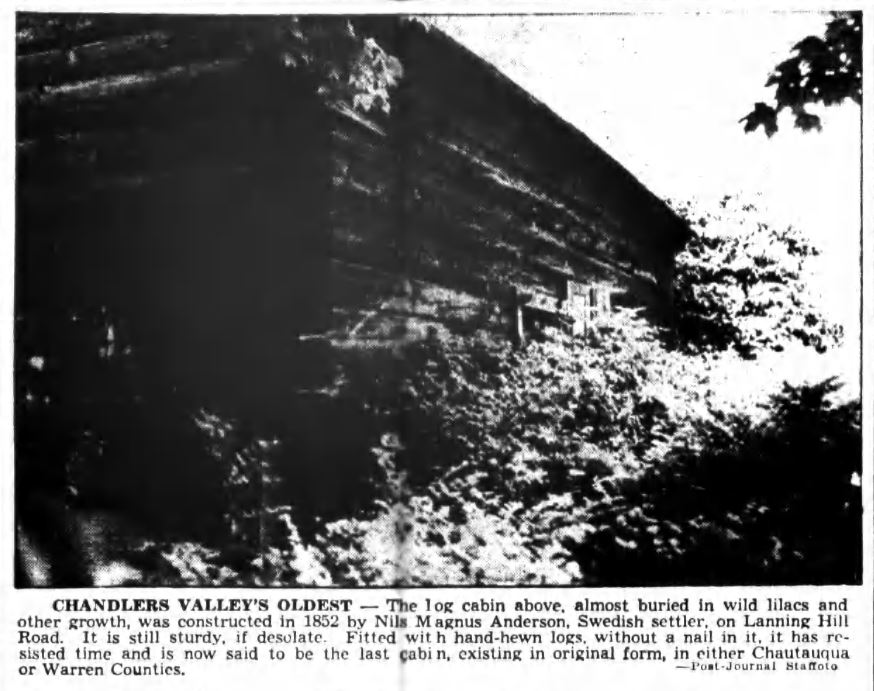
    Nels Anderson married Anna Maria Pehrsdotter in 1885 according to their enumeration in the 1900 census.  It is unclear if Anderson was still living in the same cabin he had built when he first moved to the area.  That log cabin was a curiosity story amid the publicity in 1846 for the centennial celebration in Chandlers Valley.

    photo of the headstone of Nels Anderson and wives can be found at www.findagrave.com [Find A Grave Memorial# 75455796 accessed 2016.03.20].

    Jamestown Post-Journal July 3, 1946, p 1